
Roots Vacuum Pump vs Screw Vacuum Pump: Key Differences
Roots vacuum pumps and screw vacuum pumps are both widely used in industrial vacuum systems, but they are designed for different roles.
A Roots vacuum pump is usually used as a vacuum booster. It is ideal when your process needs high pumping speed, fast evacuation, and better vacuum efficiency in a specific pressure range. However, in most industrial applications, a Roots vacuum pump needs a backing pump, such as a rotary vane vacuum pump, dry screw vacuum pump, or liquid ring vacuum pump.
A dry screw vacuum pump is commonly used as a primary vacuum pump. It can handle gas directly from the process chamber and is suitable for oil-free, clean, continuous, and demanding industrial applications, especially in chemical, pharmaceutical, semiconductor, food, and new energy industries.
In many real projects, the best solution is not choosing between Roots or screw. Instead, many industrial users choose a Roots + screw vacuum pump system, where the screw vacuum pump works as the backing pump and the Roots vacuum pump improves system pumping speed.
Need help choosing the right vacuum pump?
Send your application, gas type, target vacuum level, and required pumping speed to VACCULEX. Our engineers can recommend a suitable Roots vacuum pump, dry screw vacuum pump, or complete vacuum system.
Roots Vacuum Pump vs Screw Vacuum Pump: Quick Comparison
| Comparison Item | Roots Vacuum Pump | Screw Vacuum Pump |
|---|---|---|
| Main Role | Vacuum booster pump | Primary dry vacuum pump |
| Working Principle | Two lobed rotors transfer gas | Two screw rotors compress and discharge gas |
| Can Work Alone? | Usually needs a backing pump | Usually can work independently |
| Pumping Speed | Very high in suitable pressure range | Stable and continuous |
| Oil-Free Pump Chamber | Yes | Yes, for dry screw type |
| Best For | Fast evacuation, booster systems, large gas volume | Clean, dry, chemical, solvent, and vapor processes |
| Gas Handling | Depends on system design and backing pump | Better for direct process gas handling |
| Cost Level | Lower as a single pump, higher as a system | Higher initial cost |
| Typical System | Roots + rotary vane / screw / liquid ring pump | Single screw pump or screw + Roots booster |
| Common Industries | Metallurgy, coating, vacuum furnace, large chamber evacuation | Chemical, pharmaceutical, semiconductor, lithium battery, food processing |
Simple conclusion:
Choose a Roots vacuum pump when you need higher pumping speed or a booster stage. Choose a dry screw vacuum pump when you need clean, oil-free, continuous vacuum operation and better process gas handling.
What Is a Roots Vacuum Pump?
A Roots vacuum pump is a positive displacement vacuum pump that uses two synchronized lobed rotors to move gas through the pump chamber. The rotors rotate in opposite directions without contacting each other. This structure allows the pump to provide high pumping speed with relatively low mechanical wear.
In many industrial vacuum systems, a Roots vacuum pump is also called a Roots vacuum booster pump. It is commonly used together with a backing pump to increase pumping speed and improve vacuum system efficiency.
A Roots vacuum pump is especially suitable for applications where the system needs to evacuate a large volume of gas quickly. However, it usually cannot operate efficiently as a standalone pump from atmospheric pressure. It needs a backing pump to create the correct pressure conditions.
Common backing pumps for Roots vacuum pumps include:
- Rotary vane vacuum pump
- Dry screw vacuum pump
- Liquid ring vacuum pump
- Multi-stage vacuum pump system
For this reason, a Roots vacuum pump is often used in vacuum booster systems, vacuum drying systems, vacuum furnace systems, coating systems, and large industrial vacuum units.

What Is a Screw Vacuum Pump?
A screw vacuum pump, especially a dry screw vacuum pump, uses two screw-shaped rotors rotating in opposite directions. Gas enters from the inlet side, is trapped between the screw rotors, compressed along the pump chamber, and discharged from the exhaust side.
Unlike oil-sealed vacuum pumps, the compression chamber of a dry screw vacuum pump does not require oil or working liquid. This makes it suitable for processes that require clean vacuum, oil-free operation, or direct handling of process gas.
Dry screw vacuum pumps are widely used in industries such as:
- Chemical processing
- Pharmaceutical production
- Semiconductor manufacturing
- Lithium battery production
- Food processing
- Vacuum drying
- Solvent recovery
- New material processing
Because the pump can work as a primary vacuum pump, it is often selected for continuous industrial operation where stable performance and clean pumping are important.
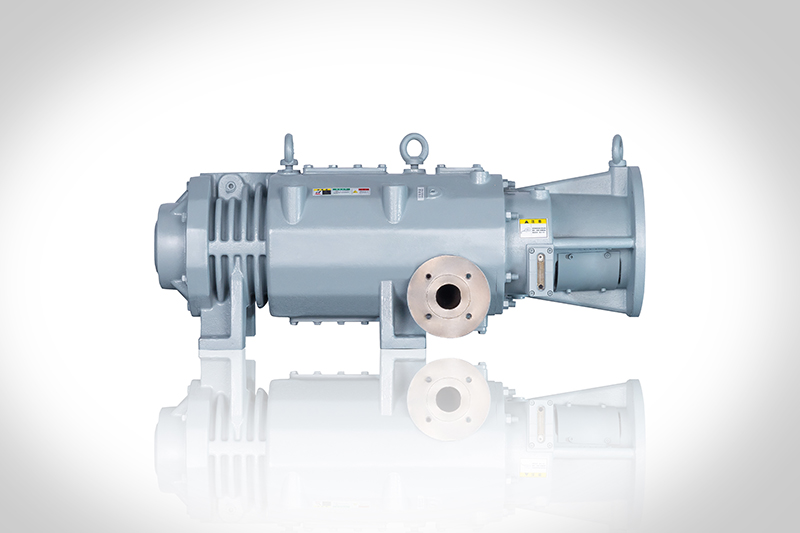
Main Differences Between Roots Vacuum Pump and Screw Vacuum Pump
Although both pumps are used in vacuum systems, their functions are different.
A Roots vacuum pump is mainly used to increase pumping speed. It moves a large amount of gas quickly but usually needs a backing pump. A dry screw vacuum pump is used to generate vacuum directly and can handle many process gases without oil in the pump chamber.
| Factor | Roots Vacuum Pump | Screw Vacuum Pump |
|---|---|---|
| Main Function | Boosting pumping speed | Primary vacuum generation |
| Internal Compression | Little or no internal compression | Gas is compressed inside the pump |
| Independent Operation | Usually not suitable alone | Usually suitable alone |
| Backing Pump Requirement | Required in most systems | Not always required |
| Pumping Speed Advantage | Very strong in suitable pressure range | Stable across continuous operation |
| Gas Handling | Depends on full system design | Better for direct process gas handling |
| Oil-Free Operation | Pump chamber is dry | Dry screw type is oil-free |
| System Complexity | Usually requires system matching | Can be simpler as a primary pump |
| Best Use | Booster stage, fast evacuation, large chamber | Clean process, chemical gas, solvent vapor, continuous operation |
In short, a Roots vacuum pump is usually selected for speed, while a screw vacuum pump is selected for clean operation, process gas handling, and continuous industrial use.
Working Principle Comparison
Roots Vacuum Pump Working Principle
A Roots vacuum pump uses two lobed rotors that rotate in opposite directions. The rotors do not contact each other or the pump chamber wall. As they rotate, gas is trapped between the rotors and the pump casing, then transferred from the inlet side to the outlet side.
The Roots pump does not usually compress gas in the same way as a screw vacuum pump. Instead, it transfers gas volume quickly. Because of this, it needs a backing pump to maintain the pressure difference and discharge the gas properly.
When properly matched with a backing pump, a Roots vacuum pump can greatly increase the pumping speed of the entire vacuum system.
Screw Vacuum Pump Working Principle
A dry screw vacuum pump uses two screw rotors. The gas enters the pump chamber, moves along the screw profile, is compressed, and is discharged through the exhaust port.
Because the pump chamber does not require oil or water, the screw vacuum pump is suitable for clean and dry vacuum applications. It can also handle certain vapors and process gases when configured with suitable materials, sealing, coating, temperature control, and exhaust treatment.
This makes the dry screw vacuum pump a strong choice for modern industrial processes where oil contamination, solvent handling, and continuous operation are key concerns.
Vacuum Performance Comparison
Vacuum Level
A dry screw vacuum pump can usually operate as a primary vacuum pump and create vacuum directly from the process chamber. It is suitable for many medium vacuum and process vacuum applications.
A Roots vacuum pump usually does not work alone. It works best when a backing pump has already reduced the system pressure. Once the system reaches the proper pressure range, the Roots pump can significantly improve pumping speed and system efficiency.
For applications that require both stable vacuum and high pumping speed, a Roots + screw vacuum pump system is often a better solution.
Pumping Speed
Pumping speed is one of the biggest advantages of a Roots vacuum pump. In the right pressure range, a Roots pump can move a large volume of gas quickly, making it suitable for fast evacuation and large chambers.
A screw vacuum pump may not always provide the same booster effect as a Roots pump, but it offers stable and continuous pumping performance. It is especially useful when the process involves vapors, solvents, or gas that must be handled directly by the pump.
Stability
For continuous industrial operation, dry screw vacuum pumps are often preferred as primary pumps because they can run steadily and handle process gas directly.
Roots vacuum pumps can also operate continuously, but their reliability depends strongly on correct system design, backing pump selection, pressure control, cooling, and overload protection.
Application Comparison: Which Pump Is Better for Your Industry?
Different industries require different vacuum solutions. The right choice depends on gas type, required vacuum level, pumping speed, process temperature, and whether the gas contains vapor, dust, solvent, or corrosive components.
| Industry / Application | Better Choice | Reason |
|---|---|---|
| Vacuum Drying | Roots + Screw System | Fast evacuation plus clean dry operation |
| Chemical Processing | Dry Screw Pump / Roots + Screw System | Better for solvent vapor and process gas |
| Pharmaceutical Production | Dry Screw Pump | Oil-free and clean vacuum requirement |
| Food Processing | Dry Screw Pump / Roots System | Clean operation and stable vacuum |
| Metallurgy | Roots Vacuum Pump System | High pumping speed and large gas load |
| Vacuum Furnace | Roots Vacuum Pump System | Fast evacuation and system boosting |
| Vacuum Coating | Roots Booster System | High pumping speed support |
| Semiconductor | Dry Screw Pump | Clean, oil-free, contamination control |
| Lithium Battery | Dry Screw Pump / Roots + Screw System | Solvent handling and clean process demand |
| Environmental Recovery | Depends on Gas Type | Requires evaluation of vapor, corrosion, and exhaust treatment |
If your process mainly needs fast evacuation and high pumping speed, a Roots vacuum pump system is often more suitable. If your process needs oil-free operation, solvent handling, clean vacuum, or continuous gas handling, a dry screw vacuum pump is often the better starting point.
Cost Comparison: Roots Vacuum Pump vs Screw Vacuum Pump
Cost is an important factor, but buyers should compare the total system cost instead of only the single pump price.
A single Roots vacuum pump is usually less expensive than a dry screw vacuum pump. However, because a Roots pump usually needs a backing pump, valves, control system, protection devices, and system matching, the total cost may increase.
A dry screw vacuum pump usually has a higher initial purchase cost, but it may simplify the system and reduce contamination risk in clean or chemical processes.
| Cost Item | Roots Vacuum Pump | Screw Vacuum Pump |
|---|---|---|
| Single Pump Price | Usually lower | Usually higher |
| System Cost | May increase due to backing pump and accessories | Higher initial cost, but may simplify system |
| Installation Cost | Depends on system matching | Often easier as a primary pump |
| Maintenance Cost | Depends on Roots pump and backing pump | Focused on sealing, bearings, cooling, and gas handling |
| Energy Cost | Efficient in booster pressure range | Stable for continuous operation |
| Best Cost Strategy | Use as booster where high pumping speed is needed | Use as primary dry pump for demanding processes |
For example, if your factory already has a suitable backing pump and only needs faster evacuation, adding a Roots vacuum booster may be cost-effective. But if your process requires clean, dry, oil-free pumping with solvent or vapor handling, a dry screw vacuum pump may offer better long-term value.
Recommended: Roots Vacuum Pump Price Guide 2026
Want to compare Roots pump cost and screw pump cost for your project?
Send your working pressure, gas type, and production process to VACCULEX for a system-based quotation.
Maintenance Comparison
Roots Vacuum Pump Maintenance
Roots vacuum pump maintenance is closely related to the entire vacuum system. Since the Roots pump usually works with a backing pump, the performance of the backing pump directly affects the stability of the Roots pump.
Common maintenance points include:
- Checking gear oil level
- Checking shaft seals
- Monitoring rotor clearance
- Preventing overload
- Avoiding overheating
- Checking the backing pump condition
- Ensuring proper pressure control
- Inspecting vibration and noise
A Roots vacuum pump can be reliable for long-term use, but it must be operated within the correct pressure and temperature range.
Screw Vacuum Pump Maintenance
A dry screw vacuum pump has an oil-free compression chamber, so there is less risk of oil contamination in the pumped gas path. However, it still needs regular maintenance.
Common maintenance points include:
- Checking bearings
- Checking shaft seals
- Inspecting cooling system
- Monitoring exhaust temperature
- Cleaning process deposits when necessary
- Checking anti-corrosion coating in chemical applications
- Inspecting motor and control system
For chemical, pharmaceutical, and solvent applications, maintenance should also consider gas composition, condensation risk, and exhaust treatment.
When Should You Choose a Roots Vacuum Pump?
You should consider a Roots vacuum pump when your process needs high pumping speed or faster evacuation.
A Roots vacuum pump is suitable when:
- You need very high pumping speed.
- Your existing vacuum system evacuates too slowly.
- You already have a suitable backing pump.
- Your process operates in a suitable low or medium vacuum range.
- You need a booster stage for your vacuum system.
- Your application involves large chamber evacuation.
- Your industry includes metallurgy, coating, vacuum furnace, degassing, or industrial drying.
A Roots vacuum pump is especially useful when the process has a large gas load and requires fast pressure reduction.
If your vacuum system is too slow or cannot maintain stable pumping speed, a Roots vacuum booster may be the right upgrade.
Ask VACCULEX to review your current vacuum system configuration.
When Should You Choose a Screw Vacuum Pump?
You should consider a dry screw vacuum pump when your process requires clean, oil-free, and continuous vacuum operation.
A dry screw vacuum pump is suitable when:
- You need oil-free operation.
- You need a primary vacuum pump.
- Your process gas contains vapor or solvent.
- Your application requires clean vacuum.
- You need continuous industrial operation.
- You want to reduce oil contamination risk.
- Your industry includes chemical, pharmaceutical, semiconductor, lithium battery, new materials, or food processing.
For many modern industrial applications, a dry screw vacuum pump is a practical choice because it can handle process gas directly and reduce the risk of oil contamination.
If your process requires clean, dry, and continuous vacuum operation, a dry screw vacuum pump may be more suitable.
Contact VACCULEX for dry screw vacuum pump selection.
Why Choose VACCULEX for Roots and Screw Vacuum Pump Solutions?
VACCULEX provides industrial vacuum pump solutions for global OEMs, distributors, engineering companies, and industrial users.
Our product range includes:
- Roots vacuum pumps
- Dry screw vacuum pumps
- Liquid ring vacuum pumps
- Roots vacuum pump systems
- Roots screw vacuum systems
- Customized industrial vacuum systems
We support applications in chemical processing, metallurgy, pharmaceutical production, food processing, semiconductor, new materials, new energy, vacuum drying, coating, environmental protection, and general industrial manufacturing.
| VACCULEX Advantage | Value for Buyers |
|---|---|
| Full Product Range | Roots pumps, screw pumps, liquid ring pumps, and complete systems |
| Engineering Selection | Model selection based on real working conditions |
| Custom System Design | Roots + screw, Roots + liquid ring, and multi-stage systems |
| Factory-Direct Supply | Suitable for OEMs, distributors, and project buyers |
| Industrial Application Experience | Chemical, metallurgy, pharma, food, semiconductor, new energy |
| Technical Support | Help buyers choose the right pump and system configuration |
Whether you need a single Roots vacuum pump, a dry screw vacuum pump, or a complete vacuum system, VACCULEX can provide a practical solution based on your working conditions.
Tell us your gas type, target vacuum level, pumping speed, voltage, and application.
VACCULEX engineers can help you choose between a Roots vacuum pump, screw vacuum pump, or complete vacuum system.
FAQ: Roots Vacuum Pump Price 2026
The main difference is their function. A Roots vacuum pump is usually used as a booster pump to increase pumping speed, while a dry screw vacuum pump can work as a primary vacuum pump for oil-free and continuous industrial operation.
In most industrial applications, a Roots vacuum pump needs a backing pump. Common backing pumps include rotary vane vacuum pumps, dry screw vacuum pumps, and liquid ring vacuum pumps.
A dry screw vacuum pump has an oil-free compression chamber. This makes it suitable for clean, chemical, pharmaceutical, semiconductor, and food processing applications.
A Roots vacuum pump can provide very high pumping speed in a suitable pressure range, especially when used as a booster pump in a vacuum system.
A dry screw vacuum pump, or a Roots + screw vacuum pump system, is often better for chemical applications because it can handle process gas, solvent vapor, and oil-free operation more effectively.
A single Roots vacuum pump is usually cheaper than a dry screw vacuum pump. However, a Roots pump often needs a backing pump and system accessories, so buyers should compare total system cost instead of only single pump price.
Conclusion
Roots vacuum pumps and screw vacuum pumps are not direct replacements in every application. They serve different roles in industrial vacuum systems.
A Roots vacuum pump is better when your process needs high pumping speed, fast evacuation, or a booster stage for a larger vacuum system. It is commonly used in metallurgy, vacuum furnace, coating, large chamber evacuation, and industrial drying systems.
A dry screw vacuum pump is better when your process needs oil-free operation, clean vacuum, continuous pumping, and better process gas handling. It is commonly used in chemical, pharmaceutical, semiconductor, lithium battery, food processing, and new material applications.
For many demanding industrial projects, the best solution is a Roots + screw vacuum pump system. This configuration combines the high pumping speed of the Roots vacuum pump with the clean and stable operation of the dry screw vacuum pump.
Need help choosing the right vacuum pump?
Contact VACCULEX with your application, gas type, required vacuum level, and pumping speed. Our engineers will recommend the most suitable Roots vacuum pump, screw vacuum pump, or complete vacuum system for your project.